
A Damaged Barrier Isn’t a Dryness Problem. It’s a Mortar Problem.
A peer-reviewed guide to how your skin barrier is built, what wears it down, and what a barrier repair moisturiser has to do at each layer to rebuild it.
You’ve probably felt it before you could name it. Skin that feels tight ten minutes after washing. A toner that suddenly stings. Flaky patches around the nose by evening, even though you moisturised in the morning. A new serum that used to feel fine and now burns.
So you do the obvious thing: more moisturiser, a heavier cream, another layer at night. It helps for a few hours, then the tightness comes back.
There’s a reason for that. A compromised barrier doesn’t need more moisture poured on top. It needs the structure that holds moisture in to be rebuilt, and that’s a different job.
What Is the Skin Barrier?
Your skin barrier lives in the outermost layer of your skin, the stratum corneum. It’s remarkably thin: about 15–20 layers of flattened, dead skin cells called corneocytes, roughly 10–20 micrometres in total 1.
Dermatologists describe it as a brick-and-mortar wall 1, 2. The corneocytes are the bricks. Each one is packed with natural moisturising factor (NMF), a mix of amino acids and other water-binding compounds that keep the bricks hydrated from inside 2. The mortar between them is a lipid matrix made mostly of three fats (ceramides, cholesterol and free fatty acids) in a roughly equal 1:1:1 ratio 1.
That mortar does two things at once. It keeps water in, and it keeps irritants, allergens and microbes out 2. When it’s intact, your skin loses water slowly and evenly. When it’s patchy, water escapes faster. Dermatologists call this transepidermal water loss (TEWL), and they measure it as a sign of how well the barrier is working 2.

Read diagram text
Where your skin barrier actually sits. Stratum corneum: the barrier, 15–20 layers of flattened cells, 10–20 µm thick [1]. Living epidermis: where new skin cells and the barrier’s lipids are made. Dermis: collagen, elastin and blood vessels. Subcutaneous fat: cushioning and insulation.
Bricks: corneocytes, packed with natural moisturising factor (NMF) that holds water inside each cell [2]. Mortar: ceramides, cholesterol and free fatty acids, roughly 1:1:1 [1]. Keeps water in and irritants out [2].
Sources: [1] Kahraman et al., Cosmetics, 2019. [2] Rajkumar et al., Skin Pharmacol Physiol, 2023. Illustration not to scale.
The layers of your skin, and where the barrier actually sits.
What Wears the Barrier Down
The barrier is under constant pressure from ordinary life:
- Dry air and cold. A review in the Journal of the European Academy of Dermatology and Venereology concluded that low humidity and low temperatures lead to a general decrease in skin barrier function, and make skin more reactive to irritants 3. Think North Indian winters, or eight hours in an air-conditioned office.
- Harsh or alkaline cleansers. Alcohols and detergents reduce NMF and hydration and increase TEWL. In one study, applying an alkaline skincare product for five weeks left skin losing significantly more water after an irritant challenge 2.
For brown skin, there’s a second cost. Postinflammatory hyperpigmentation is triggered by inflammation or injury to the skin, and it occurs with greater frequency and severity in skin of colour 4. Irritated, reactive skin is more likely to leave marks behind. A calm, intact barrier is the foundation that every other part of your routine depends on.
How a Skin Barrier Repair Cream Works
Every good barrier repair moisturiser does three jobs, and most single-ingredient products only cover one:
- Humectants draw water in. They pull moisture into the stratum corneum, and many are the same compounds found in your skin’s own NMF 2.
- Emollients rebuild the mortar. They work their way into the lipid barrier and support the skin’s own lipid production and release 2.
- Occlusives seal the surface. They form a protective layer that reduces water loss 2.
There’s a fourth principle that most skin barrier repair products skip. The barrier lipids work as a team. In laboratory research on barrier repair, ceramides, cholesterol and free fatty acids had to be supplied in roughly equal proportions for normal recovery. Raising any one of them to a 3:1:1 ratio actually sped recovery up 5. More of one ingredient isn’t the answer. The right combination is.
That’s how to judge the best barrier repair cream: by whether it covers all three jobs and gives the skin what it needs to rebuild its own mortar, not by the size of a single percentage.
Barrier Repair Ingredients With Actual Evidence
These are the ingredients with the strongest evidence for barrier support, grouped by the layer where they do their work.
At the surface
Sodium hyaluronate (hyaluronic acid). A powerful water-binder. In a 60-day study of 76 women, creams containing 0.1% hyaluronic acid at five different molecular weights all significantly improved skin hydration and elasticity compared with placebo 6. Size decides where it works. Molecules much larger than about 500 daltons generally can’t cross intact skin 7, so large hyaluronic acid stays on the surface as a moisture-holding film. The researchers suggested that smaller forms may penetrate further 6.
In the stratum corneum (the barrier itself)
Ceramides. These are the main structural lipid of the mortar 1. In one study, a single application of a ceramide-containing cream cut TEWL by about 22%, and the effect held for 24 hours 8.
Glycerin. A review in the British Journal of Dermatology describes glycerin as improving stratum corneum hydration, barrier function and the skin’s mechanical properties, and helping protect against irritating stimuli 9.
Linoleic acid. An essential fatty acid your body can’t make on its own, with a direct role in keeping the water barrier intact. In animal studies, a diet lacking it leads to scaly, itchy skin 10.
Squalane. Squalene makes up about 13% of human sebum, so it’s one of your skin’s own lipids 11. Squalane is its fully saturated form, which makes it highly resistant to oxidation. It’s also non-comedogenic 12.
Panthenol (provitamin B5). Panthenol increases the stratum corneum’s water content. In clinical studies using 5% dexpanthenol, TEWL fell markedly and barrier function was almost completely restored within 14 days after skin injury 13.
Colloidal oatmeal. In laboratory work, oat extracts switched on genes for skin barrier formation and lipid regulation. In a 50-person clinical study, an oat lotion significantly improved dryness, moisturisation and barrier function 14.
In the living epidermis (where the barrier is made)
Niacinamide (vitamin B3). In a landmark study in the British Journal of Dermatology, niacinamide increased ceramide production in skin cells 4.1–5.5-fold, and also raised production of free fatty acids and cholesterol. Applied to dry skin, it increased ceramide and fatty acid levels in the stratum corneum and reduced TEWL 15. Rather than only adding mortar, it helps your skin make more of its own.
Copper peptides. The most studied copper peptide, GHK-Cu, has been shown to stimulate collagen synthesis and to have antioxidant and anti-inflammatory activity. Its effects on skin have also been tested in human studies, including a 12-week facial cream trial 16.
Allantoin. Allantoin is recognised by the US FDA as a skin protectant active ingredient at 0.5–2% 17.

Read diagram text
How water moves through skin, and what keeps it there. Compromised barrier: gaps in the mortar let water escape faster; high transepidermal water loss (TEWL). With a barrier repair moisturiser: water drawn in, bound, and sealed; lower TEWL [8].
Surface film: hyaluronic acid and squalane [6,12]. Humectants (glycerin, panthenol) hold water in the barrier [9,13]. Humectants draw moisture up from deeper layers [2]. Both diagrams identify the stratum corneum and living epidermis.
Why size decides where an ingredient works. Molecules under about 500 daltons are small enough to enter the skin; larger ones stay on the surface [7]. Molecular weights: glycerin 92, niacinamide 122, allantoin 158, panthenol 205. Hyaluronic acid: 50,000–2,000,000 Da as studied [6]. Log scale; standard chemical data; not to scale. Reference numbers refer to this article.
How water moves through skin, and what keeps it there.
Enter Arō — a Barrier Repair Moisturiser Built Layer by Layer
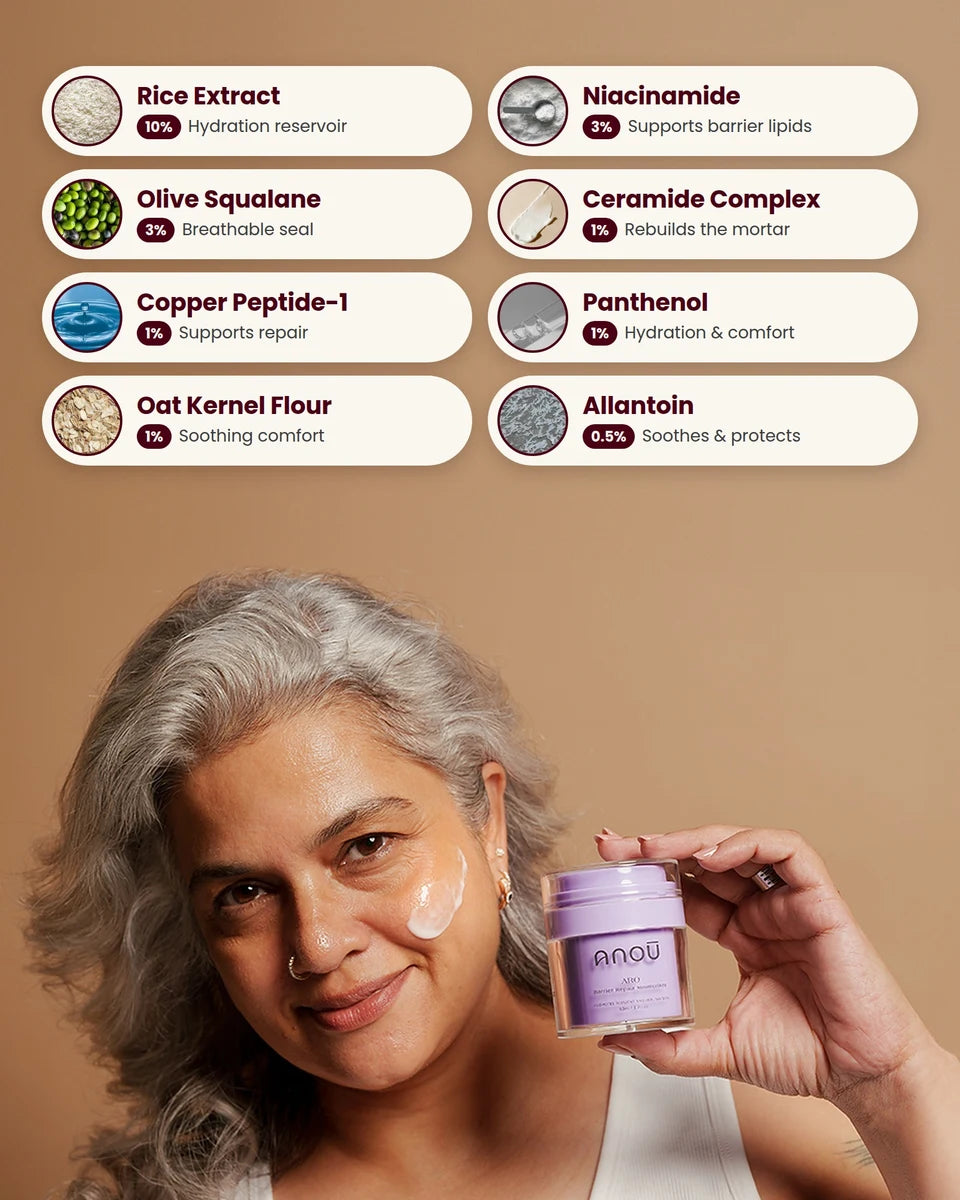
Arō is what you get when you formulate for the whole barrier rather than a single hero ingredient. It brings every ingredient above into one water-light cream, organised around the three jobs a barrier needs:
- Draw water in: 10% rice extract, 4% glycerin, 1% sodium hyaluronate, 1% panthenol and 0.1% polyglutamic acid
- Rebuild the mortar: 1% ceramide complex, 0.5% linoleic and linolenic acid, and 3% olive squalane as a breathable finish
- Help skin make its own: 3% niacinamide, to support the skin’s own ceramide and lipid production
- Calm and support repair: 1% Copper Peptide-1, 1% peptide complex, 1% oat kernel flour and 0.5% allantoin
Barrier repair moisturizers are often rich, heavy creams. Arō is built to absorb quickly and sit comfortably under sunscreen and makeup, because a barrier step only works if you’re happy to use it twice a day, in Indian humidity as well as Indian winters. Light on skin, heavy just on the results.

Read diagram text
Inside Arō, layer by layer. At the surface: a moisture-holding film. Sodium hyaluronate 1% binds water; large forms stay on top [6,7]. Olive squalane 3% is a stable form of a sebum lipid [11,12]. Polyglutamic acid 0.1% provides a water-binding film (formula).
In the stratum corneum: rebuilding the bricks and mortar. Ceramide complex 1% replaces the barrier’s main lipid [1,8]. Linoleic and linolenic acids 0.5% supply essential fatty acids [10]. Glycerin 4% is a humectant and supports barrier function [9]. Panthenol 1% raises the barrier’s water content [13]. Oat kernel flour 1% supports barrier and dryness [14]. Rice extract 10% provides base humectant support (formula).
In the living epidermis: helping skin make its own barrier. Niacinamide 3% boosts skin’s own ceramide production [15]. Copper Peptide-1 1% provides repair and antioxidant signalling [16]. Allantoin 0.5% is in the FDA skin-protectant range [17]. Peptide complex 1% provides repair support (formula).
Reference numbers refer to this article. ‘Formula’ means described by ingredient function, not a cited clinical claim. Photos: Unsplash. Not to scale.
Every ingredient in Arō, mapped to the layer where it works.

Arō Barrier Repair Moisturiser.
How to Use It, and What to Expect
Morning: cleanser → serums (optional) → Arō → sunscreen Night: cleanser → treatment (optional) → Arō as your last step
Barrier repair works on two timelines. Comfort can come quickly: in the ceramide-cream study, water loss dropped within two hours of a single application 8. Rebuilding the structure takes longer. In the hyaluronic acid study, results were measured at 30 and 60 days of twice-daily use 6. Results vary from person to person, so give your skin several weeks of consistent use before you judge it.
If you’re treating pigmentation, barrier repair also helps the treatment work. Irritation is one of the triggers for new marks 4, so a calm, hydrated barrier gives a pigment treatment like Dalí the best conditions to work in. That’s the thinking behind the Nourish and Treat Duo: Arō morning and night, with Dalí added at night.
Not sure what your skin needs? Take the skin quiz.
The Bottom Line, Briefly
Your barrier didn’t break down because you used too little moisturiser. It wore down because the mortar holding it together thinned out. The skin barrier repair products that work are the ones that draw water in, rebuild the lipids and help skin make its own, every day.
Arō is built to do all three.
Frequently Asked Questions
What is a skin barrier repair cream?
A skin barrier repair cream is a moisturiser formulated to rebuild the stratum corneum, the outermost layer of skin, rather than just hydrate its surface. It combines humectants that draw in water, emollient lipids such as ceramides and fatty acids that rebuild the mortar between skin cells, and ingredients that reduce water loss.
What is the best barrier repair cream?
The best barrier repair cream covers all three barrier jobs: it draws water in, replaces barrier lipids, and reduces water loss. Look for ceramides alongside fatty acids, a humectant such as glycerin or hyaluronic acid, and niacinamide, which helps skin produce its own ceramides. Choose a texture light enough to use every morning and night.
Are barrier repair moisturizers suitable for oily skin?
Yes. Oily skin can still have a compromised barrier, because oil on the surface is not the same as intact lipids between the skin cells. Choose a lightweight, non-comedogenic barrier repair moisturiser, such as one built on squalane rather than heavy oils.
How long does a barrier repair moisturiser take to work?
Comfort can come quickly. In one study, a ceramide-containing cream reduced water loss within two hours of a single application. Rebuilding the barrier itself takes consistent daily use over several weeks, and results vary from person to person.
Can I use a barrier repair cream with actives like retinol or pigmentation treatments?
Yes, and it’s a good idea. Actives can be irritating, and irritation can trigger new pigmentation in brown skin. Apply your active first and the barrier repair cream on top, and wear sunscreen every morning.
References
- Kahraman E, Kaykın M, Şahin Bektay H, Güngör S. (2019). Recent advances on topical application of ceramides to restore barrier function of skin. Cosmetics, 6(3), 52.
- Rajkumar J, Chandan N, Lio P, Shi V. (2023). The skin barrier and moisturization: function, disruption, and mechanisms of repair. Skin Pharmacology and Physiology, 36(4), 174–185.
- Engebretsen KA, Johansen JD, Kezic S, Linneberg A, Thyssen JP. (2016). The effect of environmental humidity and temperature on skin barrier function and dermatitis. Journal of the European Academy of Dermatology and Venereology, 30(2), 223–249.
- Davis EC, Callender VD. (2010). Postinflammatory hyperpigmentation: a review of the epidemiology, clinical features, and treatment options in skin of color. Journal of Clinical and Aesthetic Dermatology, 3(7), 20–31.
- Man MQ, Feingold KR, Thornfeldt CR, Elias PM. (1996). Optimization of physiological lipid mixtures for barrier repair. Journal of Investigative Dermatology, 106(5), 1096–1101.
- Pavicic T, Gauglitz GG, Lersch P, et al. (2011). Efficacy of cream-based novel formulations of hyaluronic acid of different molecular weights in anti-wrinkle treatment. Journal of Drugs in Dermatology, 10(9), 990–1000.
- Bos JD, Meinardi MM. (2000). The 500 Dalton rule for the skin penetration of chemical compounds and drugs. Experimental Dermatology, 9(3), 165–169.
- Spada F, Barnes TM, Greive KA. (2018). Skin hydration is significantly increased by a cream formulated to mimic the skin’s own natural moisturizing systems. Clinical, Cosmetic and Investigational Dermatology, 11, 491–497.
- Fluhr JW, Darlenski R, Surber C. (2008). Glycerol and the skin: holistic approach to its origin and functions. British Journal of Dermatology, 159(1), 23–34.
- Lin TK, Zhong L, Santiago JL. (2018). Anti-inflammatory and skin barrier repair effects of topical application of some plant oils. International Journal of Molecular Sciences, 19(1), 70.
- Huang ZR, Lin YK, Fang JY. (2009). Biological and pharmacological activities of squalene and related compounds: potential uses in cosmetic dermatology. Molecules, 14(1), 540–554.
- Wolosik K, Chalecka M, Gasiewska G, Palka J, Surazynski A. (2025). Squalane as a promising agent protecting UV-induced inhibition of collagen biosynthesis and wound healing in human dermal fibroblast. Molecules, 30(9), 1964.
- Gorski J, Proksch E, Baron JM, Schmid D, Zhang L. (2020). Dexpanthenol in wound healing after medical and cosmetic interventions (postprocedure wound healing). Pharmaceuticals, 13(7), 138.
- Ilnytska O, Kaur S, Chon S, et al. (2016). Colloidal oatmeal (Avena sativa) improves skin barrier through multi-therapy activity. Journal of Drugs in Dermatology, 15(6), 684–690.
- Tanno O, Ota Y, Kitamura N, Katsube T, Inoue S. (2000). Nicotinamide increases biosynthesis of ceramides as well as other stratum corneum lipids to improve the epidermal permeability barrier. British Journal of Dermatology, 143(3), 524–531.
- Pickart L, Margolina A. (2018). Regenerative and protective actions of the GHK-Cu peptide in the light of the new gene data. International Journal of Molecular Sciences, 19(7), 1987.
- U.S. Food and Drug Administration. Skin protectant active ingredients. Code of Federal Regulations, Title 21, §347.10.
Keep reading
All articles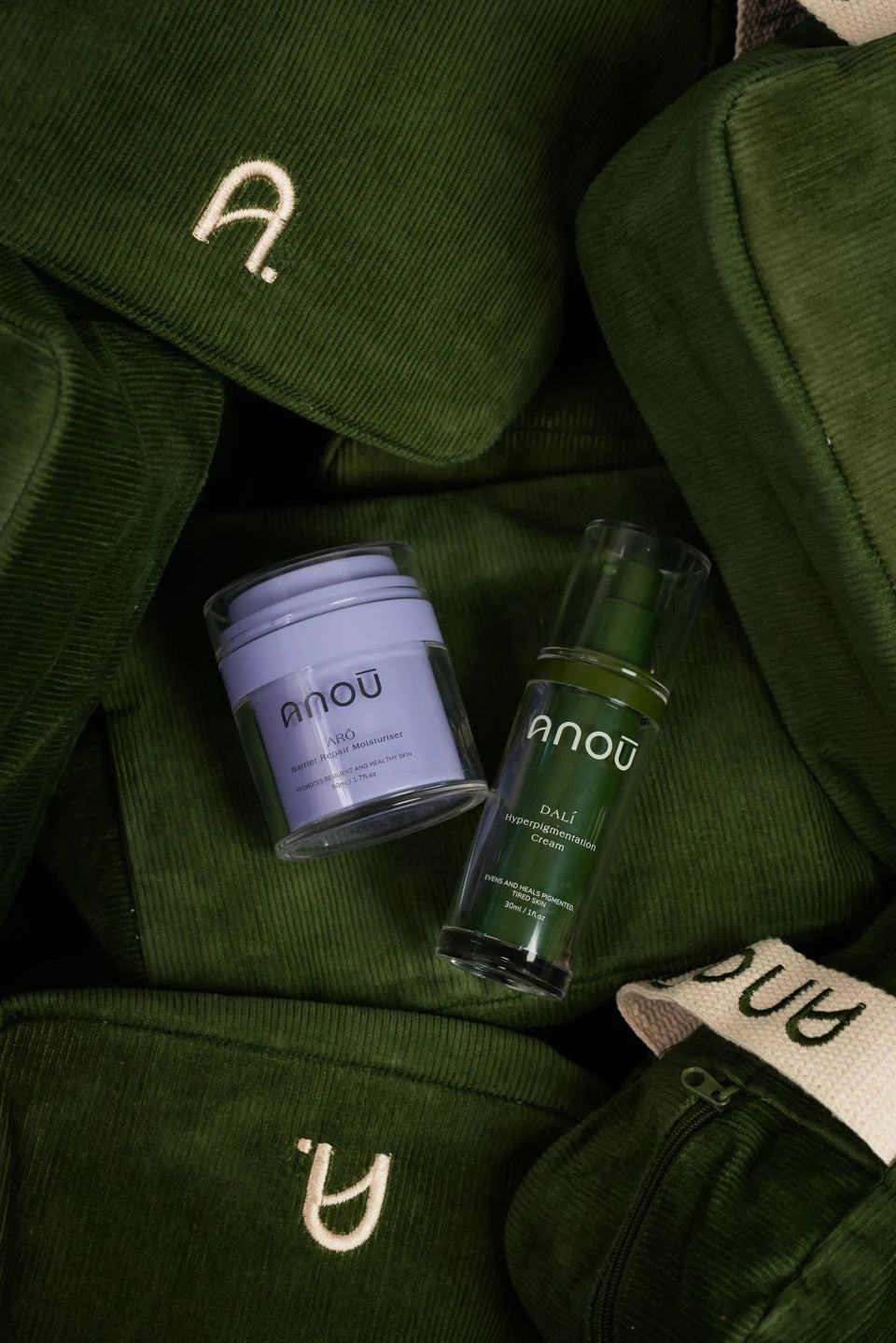
A two-step routine for even skin tone
The best skin care routine for uneven tone isn't more steps, it's the right two. Read how a treatment step and a barrier-repair step work together, and which ingredients do the work.
Read story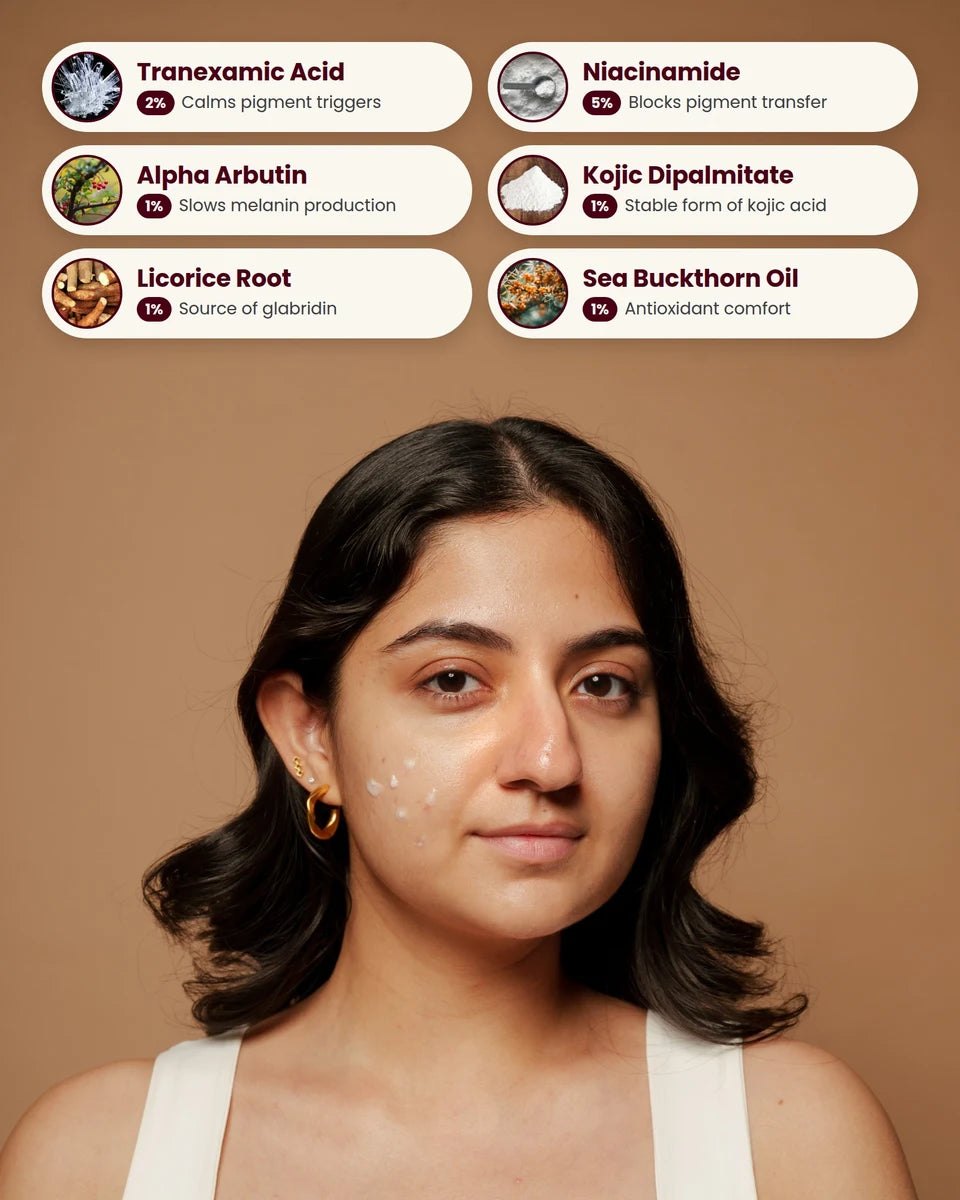
Understanding melasma
Most melasma creams only interrupt one step of pigment production. Read why melasma needs a multi-pathway cream, and what to look for in a melasma treatment cream that actually works.
Read story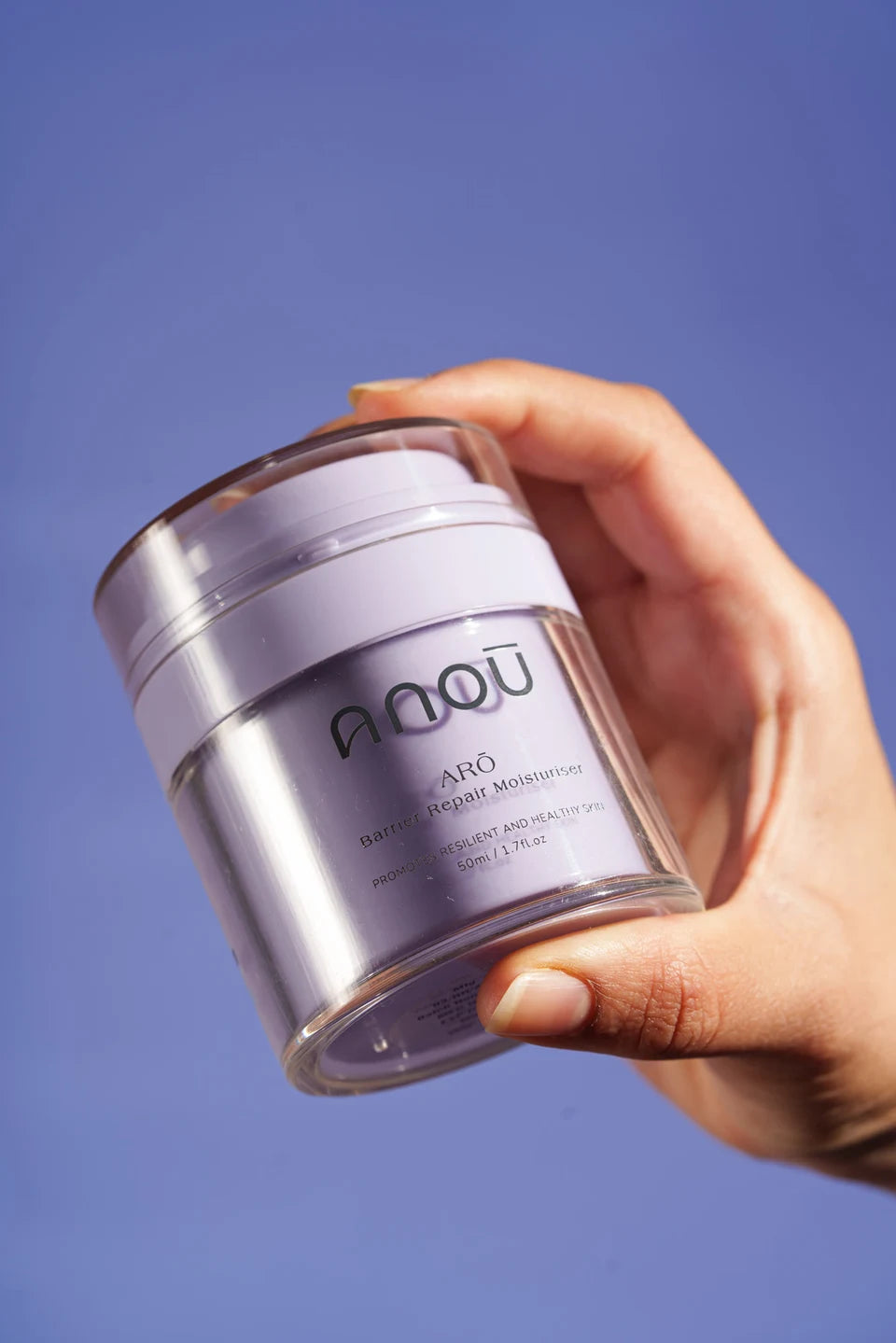
Pregnancy skincare: what to use, what to skip
Evidence-based pregnancy-safe skincare guide: which ingredients to skip, what to use, and how to read a pregnancy-safe moisturiser label.
Read story